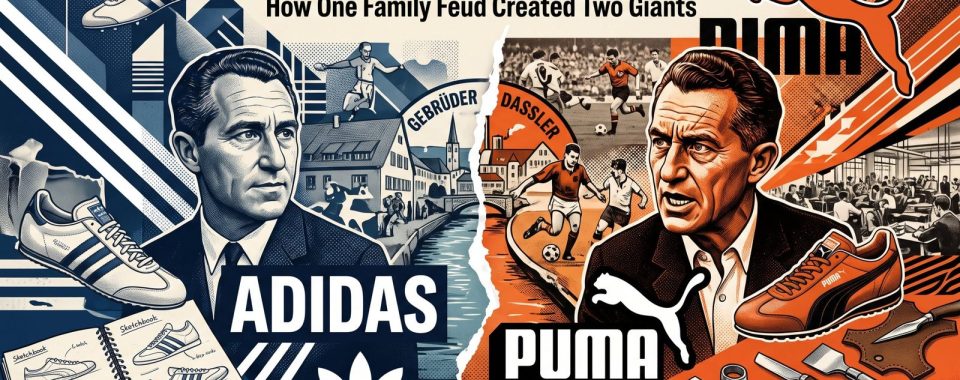
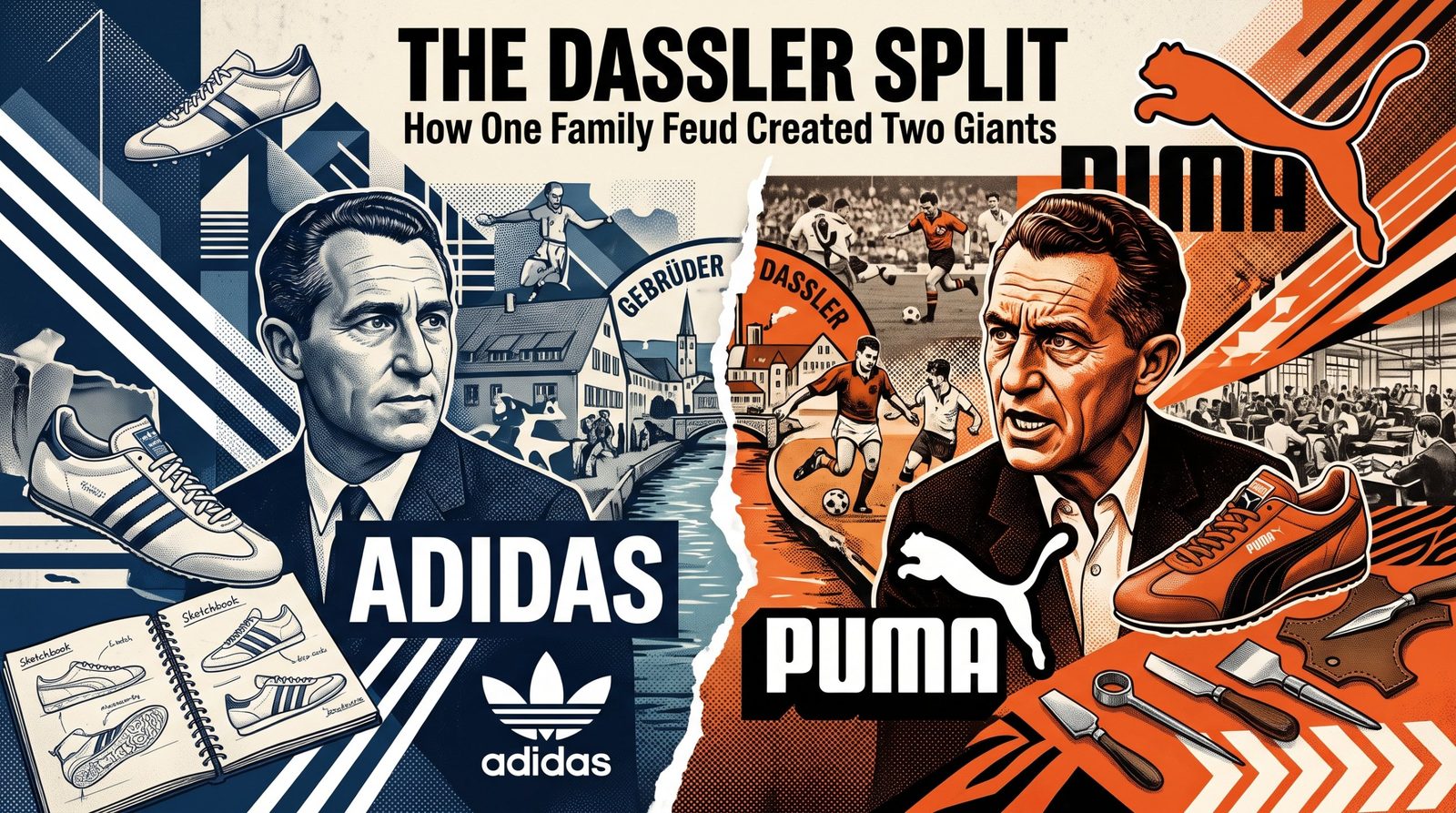
Adidas and Puma began as the same company. Same two founders, same small town in Bavaria, same factory, same craft. Today you can tell them apart from across a stadium, and the shoes have little to do with it. The gap comes from positioning. Each brother decided what his brand would stand for and how it would win, then kept repeating it for decades. Because both brands started from one company, the Dassler story is about as close as business gets to a controlled experiment in brand positioning. Every difference between them was a choice.
Here’s how two brothers who couldn’t stand each other ended up building two of the best-known brands in sport, and what any business owner can take from it.
A shoe company in a laundry room
Adolf “Adi” Dassler and his older brother Rudolf grew up in Herzogenaurach, a small town in northern Bavaria. In the 1920s, Adi started making sports shoes in his mother’s laundry room, and Rudolf soon joined him. The business became Gebrüder Dassler Schuhfabrik, the Dassler Brothers Shoe Factory.
The split in roles was clear from the start. Adi was quiet and happiest at the workbench, testing new spikes and studs. Rudolf was the outgoing one who liked selling and shaking hands. For a while, that mix worked very well.
The Olympic gamble that made their name
At the 1936 Berlin Olympics, Adi got a pair of Dassler spikes to the American sprinter Jesse Owens. Owens won four gold medals, and the whole world saw the shoes.
This was athlete endorsement before anyone called it that. The brothers worked out early that the fastest way to earn trust was to put the product on the person everyone was already watching. Orders came in from around the world.
How the brothers fell apart
Success didn’t keep the family together. The brothers and their wives lived under the same roof, and the wives didn’t get along. Then came the war. Both brothers had joined the Nazi party, and the war years brought suspicion and accusations from both sides.
One story gets told more than any other. During an Allied air raid in 1943, Adi and his wife climbed into a bomb shelter where Rudolf’s family was already sheltering. Adi muttered something like “the dirty bastards are back again.” He meant the bombers. Rudolf was sure he meant him.
Later Rudolf was drafted. After the war, American forces held him, and he believed his brother had informed on him. Nobody in either family has ever said for certain what the final break was. By 1948 it didn’t matter anymore.
1948: one company becomes two
The brothers divided the company’s machines and workers between them, and as far as anyone knows, they never really spoke again.
Rudolf moved to the other side of the Aurach river and in 1948 registered a company called Ruda, a mix of his first and last names. Within the year he renamed it Puma, after the big cat. A one-word animal name that works in almost any language and suggests speed was a smart move for a brand that wanted to sell beyond Germany.
In 1949, Adi registered his half as Adidas, from “Adi” and “Dassler.” He kept the original factory and, true to form, kept his focus on the product.
The town of bent necks
The feud didn’t stay inside the family. Herzogenaurach split with it. Puma’s factory sat south of the river and Adidas’s sat to the north, and workers, families and neighbors picked a side.
People shopped at different bakeries and drank in different pubs. The town’s two biggest football clubs were sponsored by opposite brands. Locals say people looked down at your shoes before deciding whether to talk to you, which is why Herzogenaurach became known as “the town of bent necks.”
The brothers never made peace. Rudolf died in 1974 and Adi in 1978. They are buried in the same cemetery, at opposite ends.
Two brands, two positions
With the same roots and the same products, each brand leaned into what its founder did best.
Adidas became the engineer’s brand. Its big moment came at the 1954 World Cup in Switzerland, the first one shown on television. West Germany wore Adidas boots with screw-in studs that could be changed to suit a wet pitch. They beat the heavily favored Hungarian team in the final, a game Germans still call the Miracle of Bern. Adidas got worldwide attention for a product that did something the competition’s didn’t, and it grew faster and bigger than Puma in the years that followed.
Puma became the dealmaker’s brand. It paid athletes to wear its shoes and went after attention. At the 1960 Rome Olympics, Puma paid German sprinter Armin Hary to wear its spikes in the 100-meter final, which he won.
The boldest Puma move came from the next generation. Before the 1970 World Cup, Rudolf’s son Armin, who ran Puma, and Adi’s son Horst, from Adidas, agreed to what became known as the Pelé Pact. Neither company would sign Pelé, the most famous footballer alive, because a bidding war would cost them both too much.
Puma broke it. As the story goes, just before Brazil’s quarter-final against Peru, Pelé asked the referee to wait, knelt down and slowly tied the laces of his Puma boots while the cameras zoomed in. Millions of viewers saw it. Brazil went on to win the tournament, and Puma’s image and sales got a big lift.
What the Dassler feud teaches about brand positioning
Your position should match who you really are
Adidas didn’t choose innovation as a slogan. It came from Adi, who spent his life at the workbench. Puma’s bold, deal-driven style came from Rudolf the salesman. Positions that match a company’s real strengths are easier to keep, because the team lives them without trying. Before you write a tagline, look at what your business already does better than anyone else.
Same product, different position
In 1948 the two companies made close to the same shoes, with the same skills and the same customers. What separated them was what each one chose to stand for. Most small businesses sell something a competitor also sells. A clear position is how a customer tells you apart.
A rival can sharpen your story
Each brother pushed the other to chase bigger athletes and better products. A clear “us versus them” also gives customers something to believe in and a side to pick. You don’t need a family feud to use this. Knowing exactly who you’re up against, and saying plainly how you’re different, makes your marketing sharper.
Borrow trust from people your customers already watch
Jesse Owens, the 1954 German team and Pelé did more for these brands than any ad. For a local business, that might be a respected client, a well-known local figure or a community event. Put your product where trusted people are already looking.
People buy what says something about them
In Herzogenaurach, your shoes told everyone which side of the river you belonged to. When buying from you becomes part of how customers see themselves, you get a kind of loyalty that discounts can’t buy.
Let competition push you, not run you
The feud drove both companies forward, and it also cost the family dearly. The brothers spent the rest of their lives watching each other instead of making peace. Keep an eye on the competition, but make decisions based on your customers.
The truce
For about 60 years, the two companies barely acknowledged each other. Then in 2009, on the international Peace One Day, Adidas and Puma employees played a friendly football match in Herzogenaurach, with each team made up of staff from both companies. It was a small, symbolic handshake, decades after the founders were gone.
The brands are still rivals, and they’re still headquartered a short drive apart in the same small town.
Find the position only your business can own
Golden Seller Marketing is a San Diego digital marketing agency that helps businesses decide what they stand for and say it clearly everywhere their customers look. If your business sells something competitors also sell, explore our brand positioning and branding services, or contact us at (855) 853-3456.