Every click, purchase and referral is a human decision, and human decisions follow patterns. Psychologists have spent more than a century documenting those patterns. The best marketers and brands use them, not to manipulate people, but to remove friction, communicate clearly and create experiences people want to repeat.
This guide summarizes 11 laws of human psychology that matter most in online marketing and branding, with a link to a full article on each.
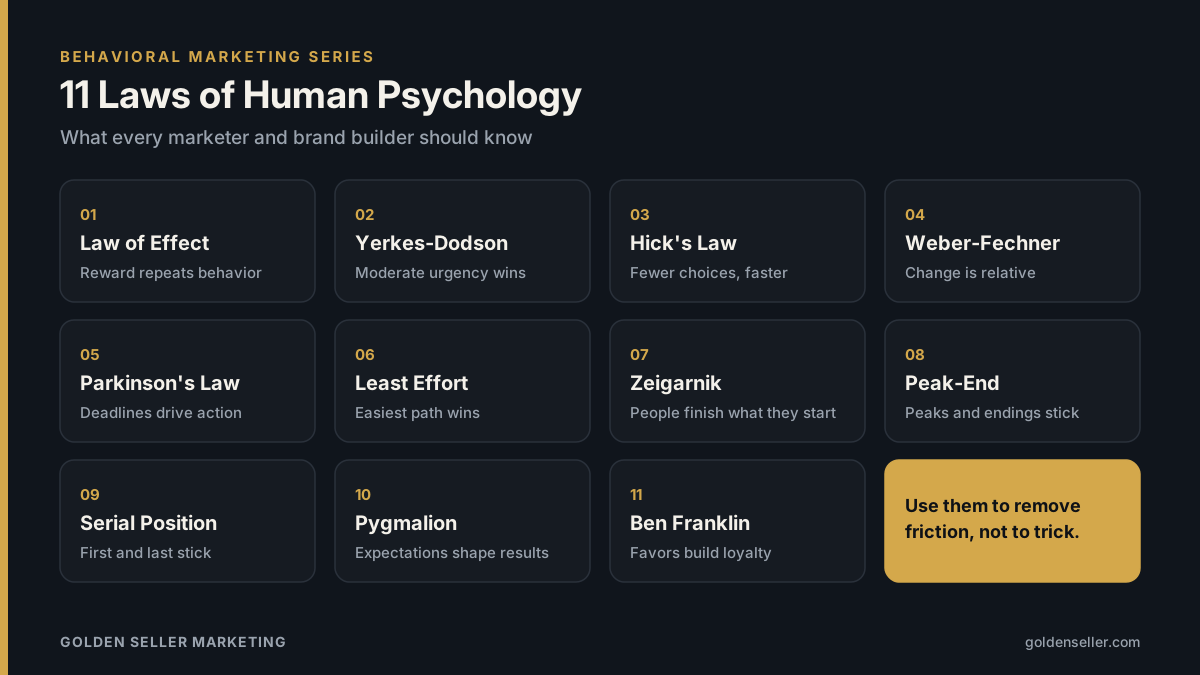
The 11 laws at a glance
1. Law of Effect
Behavior followed by a satisfying result tends to be repeated. Rewarding first actions, fast follow-ups and loyalty programs build habits around your brand.
2. Yerkes-Dodson Law
Performance peaks at moderate arousal. Ads, offers and urgency work best when they create enough excitement to act without overwhelming people.
3. Hick's Law
More choices mean slower decisions. Simpler menus, one primary call to action and fewer pricing tiers help people decide.
4. Weber-Fechner Law
People notice change relative to the starting point. It shapes how discounts, price increases and rebrands are perceived.
5. Parkinson's Law
Work expands to fill the time available. Tight project timelines and honest deadlines speed up both your team and your customers.
6. Law of Least Effort
People choose the path that takes the least effort. Fast, simple, mobile-friendly experiences win.
7. Zeigarnik Effect
Started tasks pull people to finish them. Progress bars, saved carts and content series use that drive, though the famous memory claim is weaker than often stated.
8. Peak-End Rule
Experiences are remembered by their best moment and their ending. Design signature moments and strong endings.
9. Serial Position Effect
First and last items are remembered best. Lead with your strongest point and end with the action.
10. Pygmalion Effect
Expectations can shape performance, though the effect is smaller than the popular story. Speak to who customers want to become.
11. Benjamin Franklin Effect
People like you more after doing you a favor. Asking for reviews, feedback and participation deepens loyalty.
How these laws work together
The laws overlap. A landing page might use the serial position effect to put the main benefit first, Hick’s Law to offer one clear action, the law of least effort to keep the form short, and the peak-end rule to finish with a warm, useful confirmation. A brand uses the same ideas at a larger scale: a focused position that’s easy to choose, signature moments customers remember, and an invitation for customers to take part.
A note on the science
Not every popular psychology idea is equally well supported. The serial position effect and the peak-end rule have strong research behind them. The memory version of the Zeigarnik effect has not held up well in recent meta-analysis, and the Pygmalion effect is smaller and more context-dependent than its reputation suggests. We note those limits in each article, because strategy built on accurate science performs better.
Using psychology ethically
Each of these laws can be misused: fake countdown timers, hidden price changes, manufactured scarcity. Those tactics might win a click, but they cost trust, and trust is what a brand is made of. The goal is to make good decisions easier for customers, not to trick them into bad ones.
Put behavioral psychology to work for your brand
Golden Seller Marketing applies these principles across web design, online marketing and brand and persona strategy for businesses in San Diego and across Southern California. Contact us to talk about how your website and campaigns can work with the way people actually decide.