Think of the last vacation you took. You probably don’t remember it as an average of every hour. You remember the best moment and how it ended. That’s the peak-end rule, and it shapes how customers remember your brand, your website and every interaction with your business.
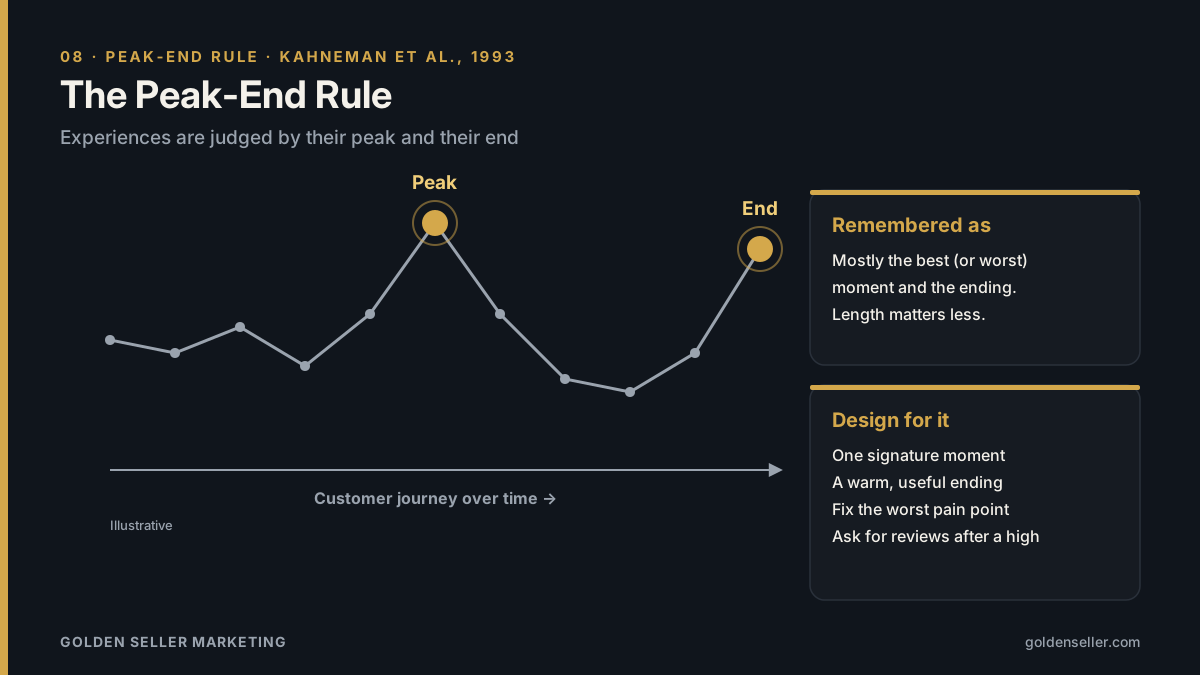
The peak-end rule says people judge an experience largely by how they felt at its most intense point and at its end, rather than by the sum or average of every moment. For marketers, that means a few moments carry most of the weight in what customers remember and tell others.
What is the peak-end rule?
The rule comes from research by Nobel Prize-winning psychologist Daniel Kahneman and colleagues in the 1990s. In one well-known study, participants held a hand in cold water for 60 seconds in one trial, and in another trial for 60 seconds followed by 30 more seconds of slightly less cold water. Many preferred to repeat the longer trial, even though it involved more total discomfort, because it ended less badly.
A related study of patients undergoing colonoscopies found that memories of the procedure were tied closely to the peak and final moments of pain. Kahneman also described “duration neglect”: how long an experience lasted matters surprisingly little to how it’s remembered. Later research suggests the rule is a strong tendency rather than an absolute law, but the core pattern has held up across many studies.
Why the peak-end rule matters in online marketing
Customers rarely remember the whole journey. They remember a standout moment and the finish. That affects:
- Reviews, which are often written about the most emotional moment or the ending.
- Repeat purchases, which depend on how the last experience felt.
- Referrals, because people retell peaks, good and bad.
- Checkout and onboarding, where the final step can color the whole website experience.
How to apply the peak-end rule
Design a deliberate peak
Find one moment in the customer journey you can make genuinely delightful: a fast, personal response to an inquiry, a surprising extra in a delivery, a results reveal in a client meeting. One great moment can lift the memory of the whole experience.
End strong
Pay close attention to the last touchpoint: the confirmation page, the thank-you email, the final invoice, the project wrap-up. A warm, useful ending (a clear next step, a thank-you, a helpful resource) leaves a better memory than a generic “Order received.”
Fix the worst moment
Negative peaks count too. A rude support interaction or a confusing checkout error can define how someone remembers your brand. Find and fix the biggest pain point before polishing everything else.
Ask for reviews at the right time
Request reviews right after a positive peak or a successful completion, when the memory is fresh and good.
Close every campaign and project well
For service businesses, a project recap that shows results and thanks the client creates a positive ending that shapes the whole relationship.
The peak-end rule and branding
A brand is, in large part, the memory people carry about you. Because those memories are built from peaks and endings, branding isn’t only logos and messaging; it’s the moments you design. Companies known for remarkable customer experiences often focus on a few signature moments rather than trying to make every interaction extraordinary.
Identify your brand’s signature moment, the thing customers mention when they recommend you, and invest in it. Then make sure every ending, from the last page of your website to the last email in a sequence, reflects the brand you want remembered.
Common mistakes
- Spreading effort evenly across every touchpoint instead of investing in peaks and endings.
- Ignoring the end of the journey, such as cancellations and offboarding, which customers remember too.
- Treating it as permission to neglect the middle. A consistently poor experience still hurts.
Frequently asked questions
Who discovered the peak-end rule?
Daniel Kahneman and colleagues, through research in the 1990s including the cold-water and colonoscopy studies.
How can a small business use the peak-end rule?
Create one memorable moment in your service, end every interaction warmly and clearly, and fix your biggest customer pain point first.
Put behavioral psychology to work for your brand
Golden Seller Marketing is a San Diego digital marketing agency built on behavioral marketing: we use how people actually notice, decide and remember to shape websites, ads, content and brands. This article is part of our series on the 11 laws of human psychology every marketer should know. Explore our branding, web design and online marketing services, or contact us at (855) 853-3456.