A cliffhanger at the end of an episode, a progress bar stuck at 80%, a story that starts in an email and finishes on a landing page: unfinished things pull at our attention. That pull is often called the Zeigarnik effect, and it’s one of the most cited ideas in marketing psychology. It’s also one of the most misunderstood, so it’s worth getting the science right before building a strategy on it.
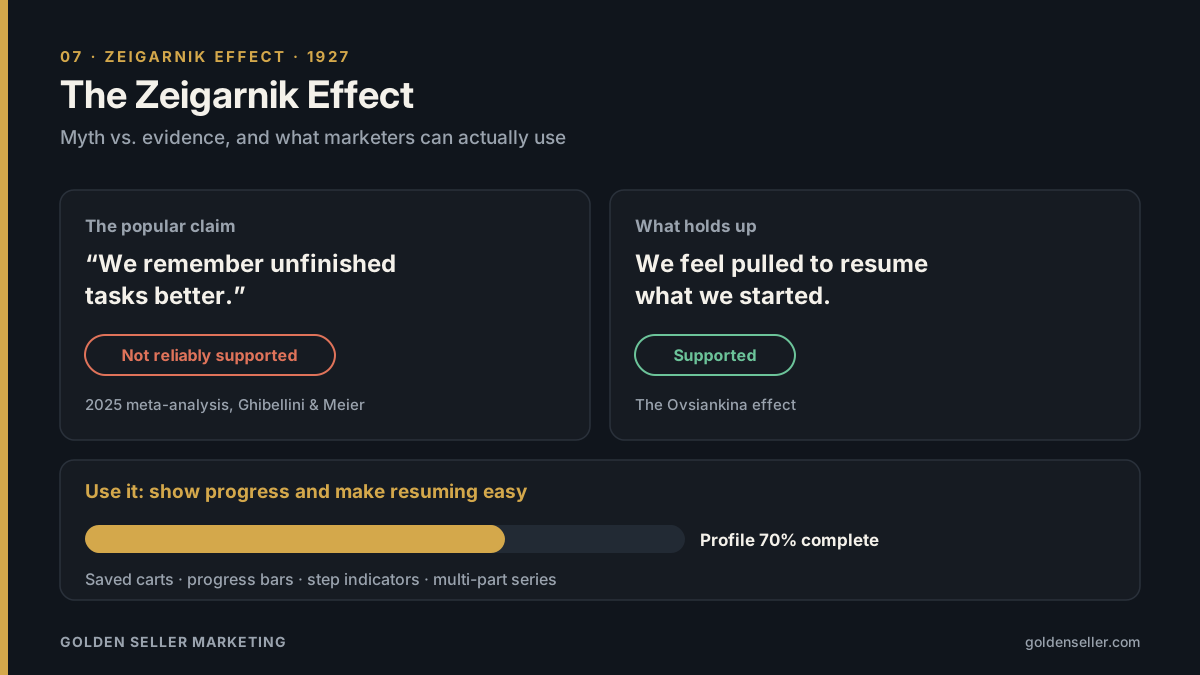
The short version: people tend to feel a drive to resume and complete tasks they’ve started. That tendency is well supported. The more famous claim, that we remember unfinished tasks better than finished ones, is much less reliable than marketing blogs suggest.
What is the Zeigarnik effect?
Lithuanian-born psychologist Bluma Zeigarnik, working in Kurt Lewin’s lab in Berlin, published a study in 1927 reporting that people recalled interrupted tasks better than completed ones. The story goes that Lewin noticed a waiter who remembered unpaid orders in detail but forgot them once the bill was settled.
A colleague in the same lab, Maria Ovsiankina, studied something related: when people are interrupted, they tend to spontaneously go back and finish the task. This is called the Ovsiankina effect.
What the research actually says
Replications of Zeigarnik’s memory finding have been mixed for decades. A 2025 meta-analysis by Ghibellini and Meier, published in Humanities and Social Sciences Communications, pooled many studies and found no reliable memory advantage for unfinished tasks. However, it did find support for the tendency to resume interrupted tasks, the Ovsiankina effect.
For marketers, that distinction matters. The useful lever is not “leave things unfinished so people remember you.” It’s “once people start something, make it easy and appealing to finish.”
Why it matters in online marketing
- Onboarding and sign-ups: People who’ve begun a process are often motivated to complete it, especially when progress is visible.
- Abandoned carts and forms: A started purchase or quote request is an open loop. Reminders that let people pick up exactly where they left off often recover sales.
- Content series: Multi-part guides, email courses and video series give people a reason to come back for the next piece.
- Profile completion: “Your profile is 70% complete” prompts are common because people like to finish what they’ve begun.
How to apply it
Show progress
Progress bars and step indicators (“Step 2 of 3”) show people how close they are to the finish and make the remaining effort feel manageable.
Make resuming effortless
Save form progress, keep cart contents, and send reminders that link straight back to where the person stopped. The resumption tendency only helps if picking up again is easy.
Start people with a head start
Letting someone begin with a step already done, such as a pre-filled field or a first free lesson, can make finishing feel more achievable.
Use open loops in content, sparingly
Teasing the next part of a series can encourage return visits, but always deliver on the promise. Clickbait that withholds the answer only frustrates.
The Zeigarnik effect and branding
Brand storytelling often works in chapters: a launch, a behind-the-scenes series, a customer journey told over time. Ongoing narratives give audiences a reason to keep following. The brand benefit comes from delivering satisfying chapters consistently, not from leaving people hanging. Customers remember the brands that finished the story well, which connects to the peak-end rule.
Common mistakes
- Overstating the memory claim. Don’t build a strategy on “unfinished means unforgettable.”
- Manipulative cliffhangers that never pay off.
- Too many reminders. One or two helpful nudges recover carts; a dozen annoy customers.
Frequently asked questions
Is the Zeigarnik effect real?
The memory version is not reliably supported according to a 2025 meta-analysis. The related tendency to resume interrupted tasks (the Ovsiankina effect) is better supported.
What is the Ovsiankina effect?
It’s the tendency to go back and complete a task that was interrupted, identified by Maria Ovsiankina in the 1920s.
Put behavioral psychology to work for your brand
Golden Seller Marketing is a San Diego digital marketing agency built on behavioral marketing: we use how people actually notice, decide and remember to shape websites, ads, content and brands. This article is part of our series on the 11 laws of human psychology every marketer should know. Explore our branding, web design and online marketing services, or contact us at (855) 853-3456.