Tell a team you expect great work and, often, they rise to it. Treat customers like valued partners and many behave like loyal ones. The idea that expectations shape performance is called the Pygmalion effect. It’s popular in leadership and marketing circles, but the research behind it is more complicated than the popular version, and that nuance matters if you want to use it well.
The Pygmalion effect is the idea that higher expectations from others lead to better performance. In marketing and branding, the more useful takeaway is about how the expectations you set, and the way you treat people, influence how they respond.
What is the Pygmalion effect?
The name comes from the Greek myth of Pygmalion, a sculptor who fell in love with his statue, and from George Bernard Shaw’s play Pygmalion, in which a professor transforms a flower seller through his expectations of her.
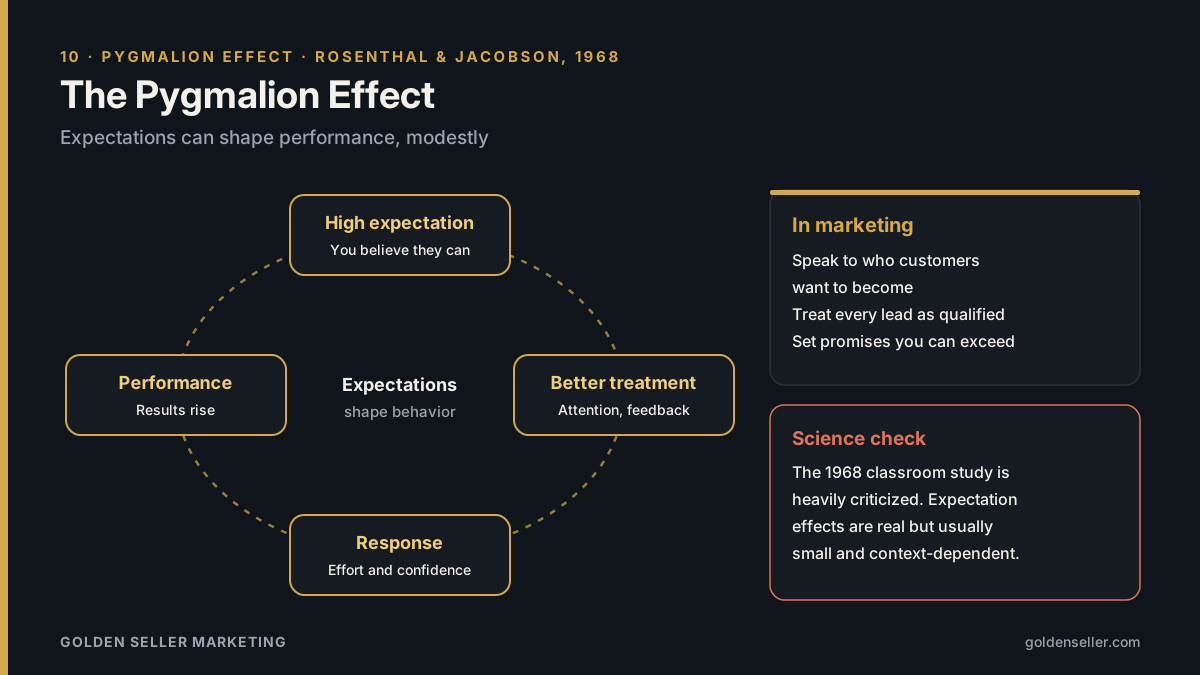
The scientific version comes from a 1968 study by psychologist Robert Rosenthal and school principal Lenore Jacobson, published as Pygmalion in the Classroom. Teachers were told that certain randomly chosen students were about to “bloom” intellectually. Those students reportedly showed larger IQ gains over the following year.
What the research actually says
The original study drew heavy criticism over its methods and data, and later attempts to replicate it produced mixed results. Reviews of the research, including work by psychologist Lee Jussim and colleagues, suggest that teacher expectation effects are real but usually small, and that they’re strongest in certain conditions, such as when people are new to a situation or when expectations are communicated through how they’re treated.
So the honest version is this: expectations can influence performance, but they’re not magic. They work mostly through behavior: more attention, better feedback, more opportunities. For marketers, that’s the practical lesson.
Why it matters in online marketing
Inside your team and agencies
Leaders who set high but achievable standards, give clear feedback and provide resources tend to get better work. Treating your marketing team or agency as a strategic partner rather than a vendor usually leads to more proactive, higher-quality output.
With customers
How a brand frames its customers can shape how they see themselves. Messaging that treats customers as capable, ambitious and smart invites them to live up to that image, for example a fitness brand that speaks to customers as athletes, or a software company that treats users as experts.
Setting expectations for results
The flip side is expectation management. Overpromising sets expectations your product can’t meet, and disappointment follows. Clear, confident, realistic promises perform better over time.
How to apply it
- Write to the customer’s best self. Speak to who your audience wants to become, not just their problems.
- Treat leads as qualified until proven otherwise. Sales teams that treat every inquiry with respect and attention often convert more of them.
- Set high, clear standards for internal and agency work, and back them with support and feedback.
- Make realistic promises that you can exceed.
- Celebrate customer success with case studies and recognition, reinforcing a positive identity.
The Pygmalion effect and branding
Many strong brands are built around an aspirational identity for their customers. The message isn’t just “buy our product”; it’s “you are the kind of person who does this.” When customers adopt that identity, loyalty follows. This is part of building a clear brand persona: knowing who your customer wants to be and speaking to that person.
Internally, brands with strong cultures often hold employees to high standards and trust them. That culture shows up in customer experience, which becomes part of the brand.
Common mistakes
- Treating it as a guarantee. High expectations alone don’t produce results; support and resources do the work.
- Flattery instead of respect. Customers can tell the difference.
- Overpromising, which creates the opposite of the intended effect.
Frequently asked questions
Is the Pygmalion effect real?
Expectation effects exist, but research suggests they’re typically small and depend on context. The original 1968 study has been widely criticized.
What is the opposite of the Pygmalion effect?
The Golem effect, in which low expectations lead to poorer performance.
Put behavioral psychology to work for your brand
Golden Seller Marketing is a San Diego digital marketing agency built on behavioral marketing: we use how people actually notice, decide and remember to shape websites, ads, content and brands. This article is part of our series on the 11 laws of human psychology every marketer should know. Explore our branding, web design and online marketing services, or contact us at (855) 853-3456.