Why do customers come back to some brands without thinking twice, while others have to win them over again every single time? A large part of the answer goes back more than a century, to a psychologist watching cats figure out how to escape a puzzle box.
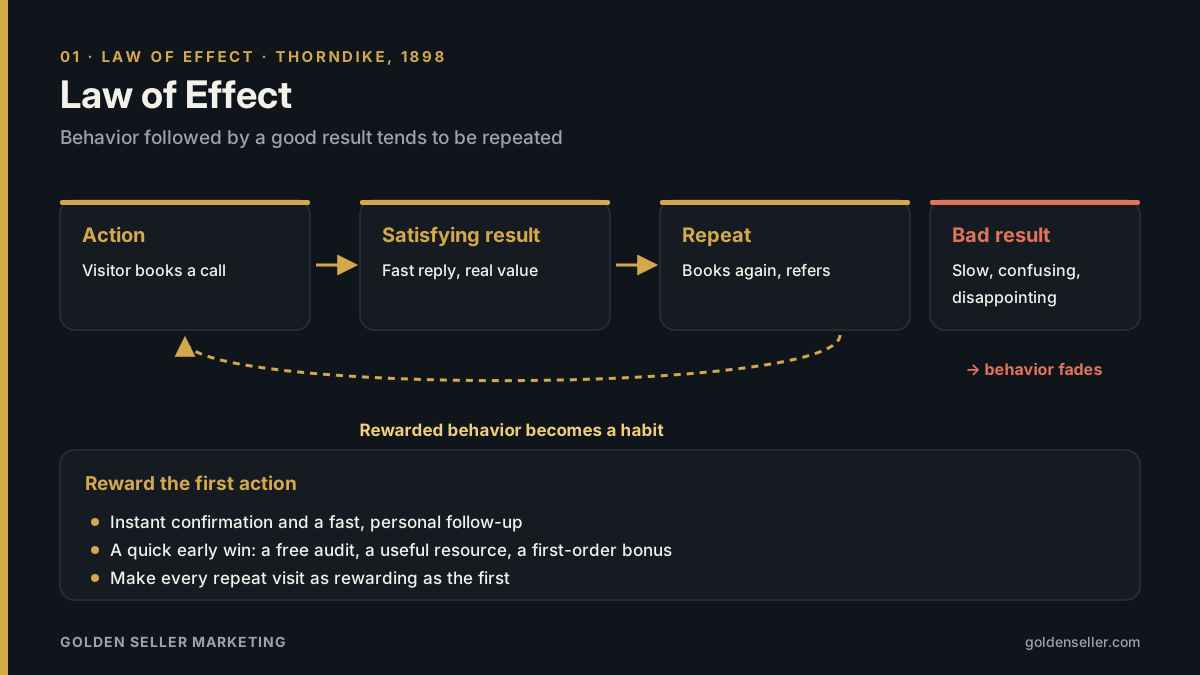
The Law of Effect says that behavior followed by a satisfying result is more likely to be repeated, and behavior followed by an unpleasant result is less likely to be repeated. In marketing, that means every interaction a customer has with your brand is quietly training them: to come back, or to stay away.
What is the Law of Effect?
American psychologist Edward Thorndike described the Law of Effect around the turn of the twentieth century. In his experiments, animals placed in a puzzle box discovered by trial and error which action opened the door. Actions that led to escape and food were repeated more quickly each time; actions that led nowhere faded away. Thorndike’s idea became a foundation for later work on reinforcement and learning, including B.F. Skinner’s research on operant conditioning.
The principle is simple: people (and animals) repeat what works out well for them. What counts as “working out well” is the part marketers can shape.
Why the Law of Effect matters in online marketing
Every digital experience is a series of small actions followed by small outcomes. Click an ad, land on a page. Fill out a form, get a response. Open an email, find something useful or not. Each outcome either reinforces the behavior or discourages it.
- Websites: if a visitor finds what they need quickly, the experience is rewarding and they’re more likely to return. If they hit slow pages, confusing navigation or a broken form, they learn your site is hard work.
- Email: subscribers who consistently get value from your emails keep opening them. Subscribers who get repeated sales pitches learn to ignore or unsubscribe.
- Social media: followers who are entertained, informed or recognized when they engage keep engaging.
- Ads and offers: the first purchase experience sets the expectation for the second. A smooth checkout and fast delivery reinforce buying again.
How to apply the Law of Effect
Reward the behavior you want, immediately
Reinforcement works best when it follows the action closely. Confirm a booking instantly. Thank a reviewer the same day. Deliver the download the moment someone signs up. Delays weaken the link between action and reward.
Design early wins into onboarding
New customers decide quickly whether a product or service is worth the effort. Give them a meaningful result early: a first report, a quick setup, a visible improvement. That first success is what makes them return.
Use loyalty and referral programs thoughtfully
Points, perks and referral rewards are direct applications of the Law of Effect. They work best when rewards feel meaningful and are easy to understand, and when the core product is already good. A reward can reinforce a good experience; it can’t rescue a bad one.
Remove the punishments you didn’t intend
Many brands accidentally punish the behavior they want: long forms for people who are ready to buy, hold music for people trying to give you money, pop-ups for people already reading. Audit your customer journey for steps that make the right action feel bad.
Acknowledge engagement publicly
Replying to comments, resharing customer posts and featuring reviews reward participation. People who are recognized tend to participate again.
The Law of Effect and branding
A brand is, in large part, the accumulated memory of outcomes. Every time a customer interacts with you and the result is good, the association between your name and a good outcome gets stronger. Over time, choosing you becomes a habit rather than a decision.
This is why consistency matters so much in branding. A brand that delivers great experiences most of the time but unpredictable ones occasionally creates doubt. Consistent delivery across your website, customer service, product and follow-up builds the reliable reinforcement that turns customers into loyal advocates.
Common mistakes
- Bribing instead of delighting. Discounts and freebies can train customers to wait for the next deal rather than to value the brand.
- Rewarding the wrong metric. Rewarding clicks or sign-ups without delivering value afterwards teaches people to sign up and leave.
- Ignoring negative reinforcement loops. A frustrating cancellation process, surprise fees or slow support teach customers to avoid you, and to tell others why.
Frequently asked questions
Who discovered the Law of Effect?
Psychologist Edward Thorndike proposed it based on his puzzle-box experiments with animals, published around the turn of the twentieth century.
Is the Law of Effect the same as operant conditioning?
They’re closely related. The Law of Effect came first; B.F. Skinner later built operant conditioning on top of it, studying reinforcement and punishment in more detail.
Put behavioral psychology to work for your brand
Golden Seller Marketing is a San Diego digital marketing agency built on behavioral marketing: we use how people actually notice, decide and remember to shape websites, ads, content and brands. This article is part of our series on the 11 laws of human psychology every marketer should know. Explore our branding, web design and online marketing services, or contact us at (855) 853-3456.