A little urgency gets people to act. Too much makes them freeze, second-guess or leave. Marketers feel this tension constantly: in countdown timers, in sales pages, in how hard an ad pushes. The Yerkes-Dodson Law is the psychology behind it.
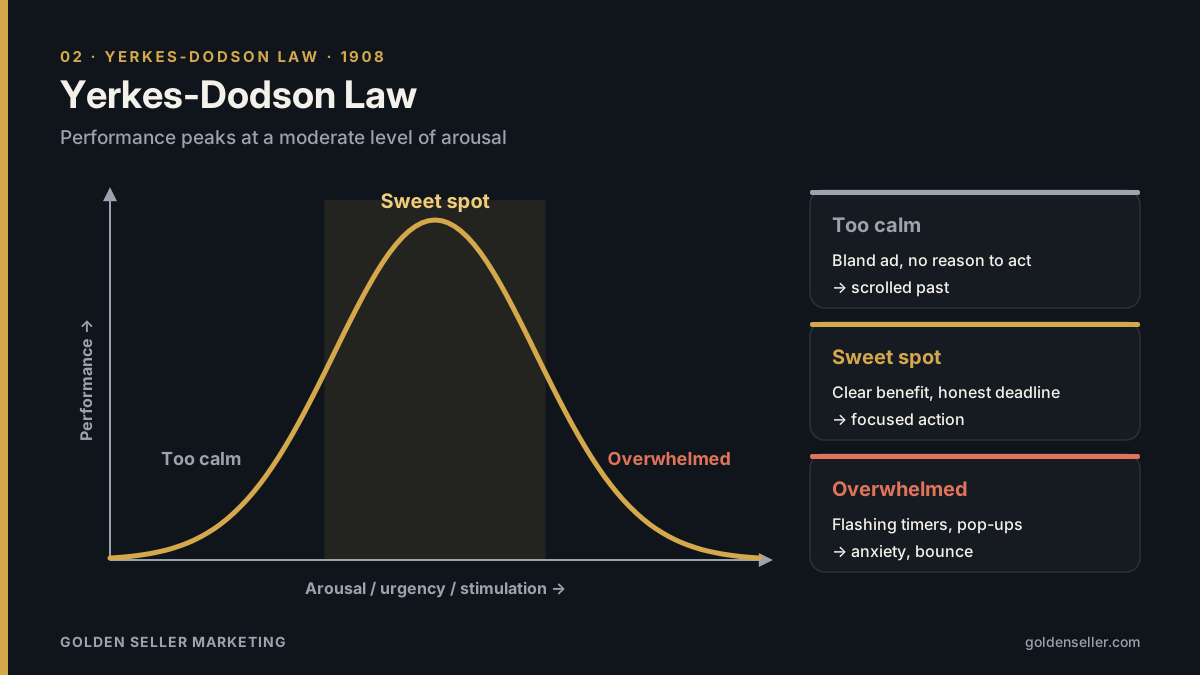
The Yerkes-Dodson Law says that performance improves with arousal (alertness, motivation, mild stress) only up to a point. Past that point, more pressure makes performance worse. For marketers, the goal is to create just enough energy to motivate action without tipping people into anxiety.
What is the Yerkes-Dodson Law?
Psychologists Robert Yerkes and John Dillingham Dodson published the original study in 1908. Working with mice, they found that a moderate level of stimulation helped the animals learn a task best, while very low or very high stimulation led to poorer results, especially when the task was difficult. Later researchers generalized the finding into the familiar “inverted U” curve: performance rises with arousal, peaks, then falls.
Two details matter for marketing. First, the ideal level of arousal is lower for complex tasks than for simple ones. Second, the curve is a model, not a precise formula; individuals and situations vary.
Why it matters in online marketing
Every marketing message adds some level of stimulation: color, motion, urgency, emotion, stakes. Too little and people scroll past. Too much and they feel pressured, distrustful or overwhelmed.
- Simple, low-cost purchases tolerate more energy. A bold sale banner on a $20 product can work well.
- Complex, high-stakes decisions need calm. Someone choosing a lawyer, a surgeon or a $40,000 remodel needs clarity and reassurance, not a ticking clock.
How to apply the Yerkes-Dodson Law
Match urgency to the decision
Limited-time offers, low-stock messages and countdown timers raise arousal. Use them for simple, impulse-friendly offers. For considered purchases, lower the pressure and raise clarity: transparent pricing, process explanations, guarantees and social proof.
Design pages that calm complex decisions
For high-stakes services, a cluttered page full of flashing elements adds stress on top of an already stressful decision. Clean layouts, plenty of white space, plain language and a clear next step keep people in the productive middle of the curve.
Use emotion, but don’t overload it
Emotional ads work because they raise arousal. Fear-based messages in particular can motivate action, but heavy fear tends to make people avoid the message instead of acting on it. Pair any tension with an immediate, credible solution.
Watch the checkout and forms
Checkout is a moment of mild stress. Surprise fees, error messages and long forms push people past the peak. Simplify the final steps so the natural excitement of buying doesn’t turn into frustration.
Pace your campaigns
Constant “last chance” emails lose their effect and raise baseline stress. Reserve high-urgency messages for genuine deadlines so they keep their power.
The Yerkes-Dodson Law and branding
Brands set an emotional baseline. Some brands live at high energy (sports drinks, entertainment, nightlife); others build their identity on calm (banks, healthcare, luxury). Neither is wrong, but the brand’s energy should match what customers need to feel to make good decisions with you.
A wealth management firm that markets like an energy drink creates the wrong kind of arousal. A children’s toy brand that markets like a law firm creates too little. Good brand positioning decides where on the curve your brand should live, and keeps every channel consistent with it. Our brand positioning work starts with that question.
Common mistakes
- Fake urgency. Timers that reset and “only 2 left” messages that never change destroy trust once noticed.
- One intensity for every audience. New visitors, returning customers and anxious first-time buyers each need different levels of energy.
- Too much at once. Pop-ups, chat bubbles, animations and banners together push visitors past the point of focus.
Frequently asked questions
What is the inverted U in the Yerkes-Dodson Law?
It’s the shape of the curve: performance increases with arousal up to an optimal point, then decreases as arousal keeps rising.
Does urgency always increase conversions?
No. Urgency helps with simple decisions but can hurt complex ones, where people need time and confidence. Test urgency against clarity rather than assuming more pressure is better.
Put behavioral psychology to work for your brand
Golden Seller Marketing is a San Diego digital marketing agency built on behavioral marketing: we use how people actually notice, decide and remember to shape websites, ads, content and brands. This article is part of our series on the 11 laws of human psychology every marketer should know. Explore our branding, web design and online marketing services, or contact us at (855) 853-3456.