
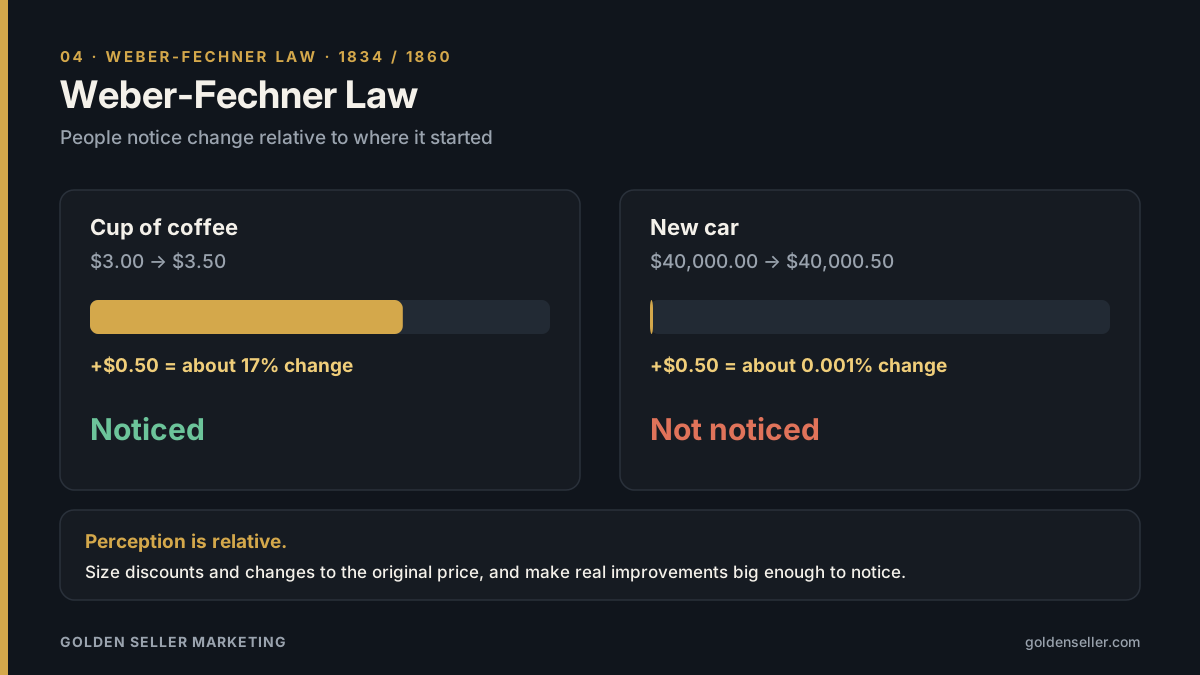
Raise the price of a $3 coffee by 50 cents and customers notice. Raise the price of a $40,000 car by 50 cents and nobody does. That difference isn’t about money; it’s about how human perception works. The Weber-Fechner Law explains it, and it shapes pricing, discounts, product changes and rebrands.
In short, people notice changes relative to the starting point, not in absolute terms. A change has to be a certain proportion of the original before it’s perceived at all, and as stimuli grow larger, each additional increase feels smaller.
What is the Weber-Fechner Law?
German physician Ernst Heinrich Weber studied how much a weight had to change before people could tell the difference. In the 1830s he found that the “just noticeable difference” was a roughly constant proportion of the original weight: a small change is easy to detect on a light object and hard to detect on a heavy one. This became known as Weber’s Law.
Gustav Fechner built on Weber’s work in 1860, proposing that perceived intensity grows with the logarithm of actual intensity. Together their ideas are called the Weber-Fechner Law. Modern research has refined the details, but the core insight, that perception is relative, holds up well and appears across senses and in how people judge prices and quantities.
Why it matters in online marketing
Discounts
A $10 discount feels significant on a $30 product and trivial on a $900 one. Small discounts on expensive items often fail to register; on high-priced offers, a meaningful percentage or a valuable bonus may be perceived more clearly than a small dollar amount.
Price increases
Businesses that need to raise prices can use the same principle carefully: small, periodic adjustments may fall below the noticeable threshold, while one large jump draws attention. Transparency still matters; customers who feel tricked lose trust quickly.
Product and packaging changes
When brands reduce package sizes slightly without changing price (often called shrinkflation), they rely on changes being hard to notice. When customers do notice, the backlash can damage trust far more than an honest price increase.
Ad testing
Tiny differences between ad variations often don’t produce meaningful differences in response, because audiences don’t perceive them. Testing bold, clearly different ideas usually teaches more than testing near-identical versions.
How to apply the Weber-Fechner Law
- Frame discounts relative to price. Show percentages when they’re impressive and dollar amounts when they’re large.
- Anchor high-value offers. Showing the full value of a bundle or package makes each component feel more substantial.
- Make improvements noticeable. If you improve a product or service, make the change large enough, or explained clearly enough, that customers actually perceive it.
- Introduce change gradually where continuity matters. Small, steady improvements to a website or brand can keep familiarity while still moving forward.
The Weber-Fechner Law and branding
Brand evolution is where this law is most visible. Many long-lived brands update their logos and visual identity in small steps over decades, keeping each change subtle enough that loyal customers still feel at home. A sudden, dramatic rebrand risks losing recognition, unless the business deliberately wants to signal that something big has changed.
The right approach depends on the goal. If your brand has strong recognition and the business is fundamentally the same, evolve gradually. If you’re repositioning, entering a new market or leaving a bad reputation behind, a noticeable change is the point. Our branding team helps decide which path fits.
Common mistakes
- Discounts too small to notice on premium products, which cut margin without changing behavior.
- Hidden reductions that customers eventually discover, damaging trust.
- Rebrands that change everything at once when the business only needed a refresh.
Frequently asked questions
What is a just noticeable difference?
It’s the smallest change in a stimulus that a person can reliably detect. Weber found it’s a roughly constant proportion of the original amount.
How does the Weber-Fechner Law apply to pricing?
Customers judge price changes relative to the original price, so the same dollar change feels large on cheap items and small on expensive ones.
Put behavioral psychology to work for your brand
Golden Seller Marketing is a San Diego digital marketing agency built on behavioral marketing: we use how people actually notice, decide and remember to shape websites, ads, content and brands. This article is part of our series on the 11 laws of human psychology every marketer should know. Explore our branding, web design and online marketing services, or contact us at (855) 853-3456.