
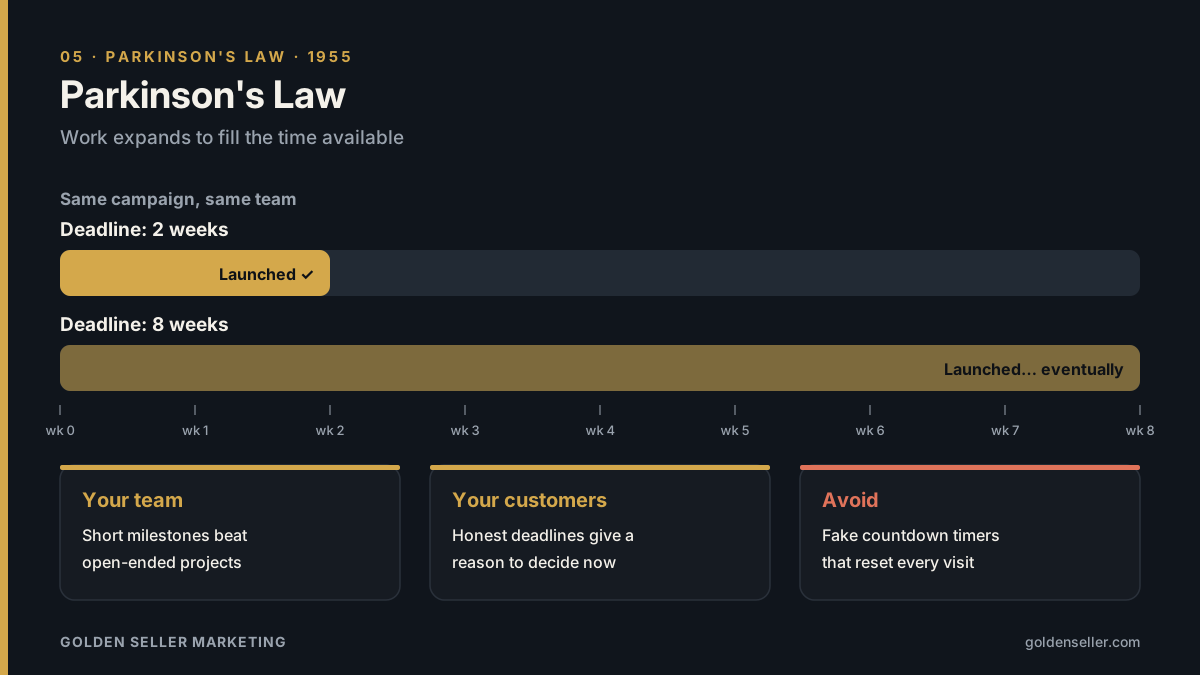
Give a team two weeks to launch a campaign and it takes two weeks. Give the same team two months and, more often than not, it takes two months. That observation, famously summed up as Parkinson’s Law, has real consequences for how marketing gets planned, produced and sold.
Parkinson’s Law states that work expands to fill the time available for its completion. In online marketing it explains why open-ended projects drift, why deadlines move customers to act, and why a brand that respects people’s time earns trust.
What is Parkinson’s Law?
British naval historian C. Northcote Parkinson introduced the idea in a satirical essay in The Economist in 1955, later expanded into the book Parkinson’s Law. He was poking fun at bureaucracy, observing that administrative staff and paperwork tended to grow regardless of how much real work existed. The opening line became the law itself: work expands to fill the time available.
It began as social commentary rather than a laboratory finding, but the pattern is familiar to anyone who has managed projects. Related research on deadlines and procrastination supports the practical point: without a clear time limit, tasks tend to stretch, and specific deadlines generally help people follow through.
Why Parkinson’s Law matters in online marketing
Inside your marketing team
Website rebuilds, rebrands and content calendars are classic victims. Without firm milestones, a website project can drift for months while competitors keep publishing and ranking. Every week a better site or campaign sits unfinished is a week of leads you didn’t get.
On the customer’s side
Customers apply the same law to buying decisions. If there’s no reason to decide now, the decision expands to fill all available time, which often means it never happens. Genuine deadlines, such as enrollment periods, seasonal availability or limited appointment slots, give people a reason to act.
How to apply Parkinson’s Law
Set short, specific deadlines for projects
Break big marketing projects into small deliverables with near-term dates. A page a week ships; “the new website sometime this quarter” slips.
Timebox creative work
Give brainstorming, design rounds and copy drafts a fixed amount of time. Constraints often improve focus, and you can always refine once the first version is live.
Launch, then improve
Digital marketing rewards iteration. A good landing page live today beats a perfect one next quarter, because real data tells you what to improve.
Use honest deadlines in offers
Promotions with a real end date, limited-capacity services and seasonal offers give customers a reason to decide. The key word is honest: fake countdown timers that reset on every visit are easy to spot and damage trust.
Shorten the customer’s path
Make the next step quick: online booking, short forms and clear calls to action reduce the time a decision takes.
Parkinson’s Law and branding
Brands that make customers wait, through slow websites, slow replies or slow onboarding, are effectively letting customer patience run out. Fast response times have become part of how people judge a company’s professionalism. A brand known for doing what it said, when it said it would, builds a reputation that no slogan can buy.
Internally, branding projects are especially prone to expansion because they involve opinions and committees. A clear scope, a decision-maker and a fixed timeline keep a rebrand from turning into a year-long debate about a logo.
Common mistakes
- Fake urgency. Deadlines that aren’t real teach customers to ignore all your deadlines.
- Unrealistic deadlines. Too little time leads to rushed, poor work. The goal is a tight but achievable timeline.
- No owner. A deadline without a responsible person is only a suggestion.
Frequently asked questions
Who came up with Parkinson’s Law?
C. Northcote Parkinson, in a 1955 essay in The Economist, later expanded into a book.
Does urgency in marketing actually work?
Genuine deadlines and limited availability can encourage decisions, but manufactured urgency tends to backfire once customers notice it.
Put behavioral psychology to work for your brand
Golden Seller Marketing is a San Diego digital marketing agency built on behavioral marketing: we use how people actually notice, decide and remember to shape websites, ads, content and brands. This article is part of our series on the 11 laws of human psychology every marketer should know. Explore our branding, web design and online marketing services, or contact us at (855) 853-3456.