
Read a list of ten items to someone and ask what they remember. They’ll usually recall the first few and the last few, while the middle blurs. That’s the serial position effect, and it quietly shapes how people read your website, your ads, your emails and your sales presentations.
The serial position effect is the tendency to remember the first and last items in a sequence best. In online marketing it tells you where to put the information that matters most.
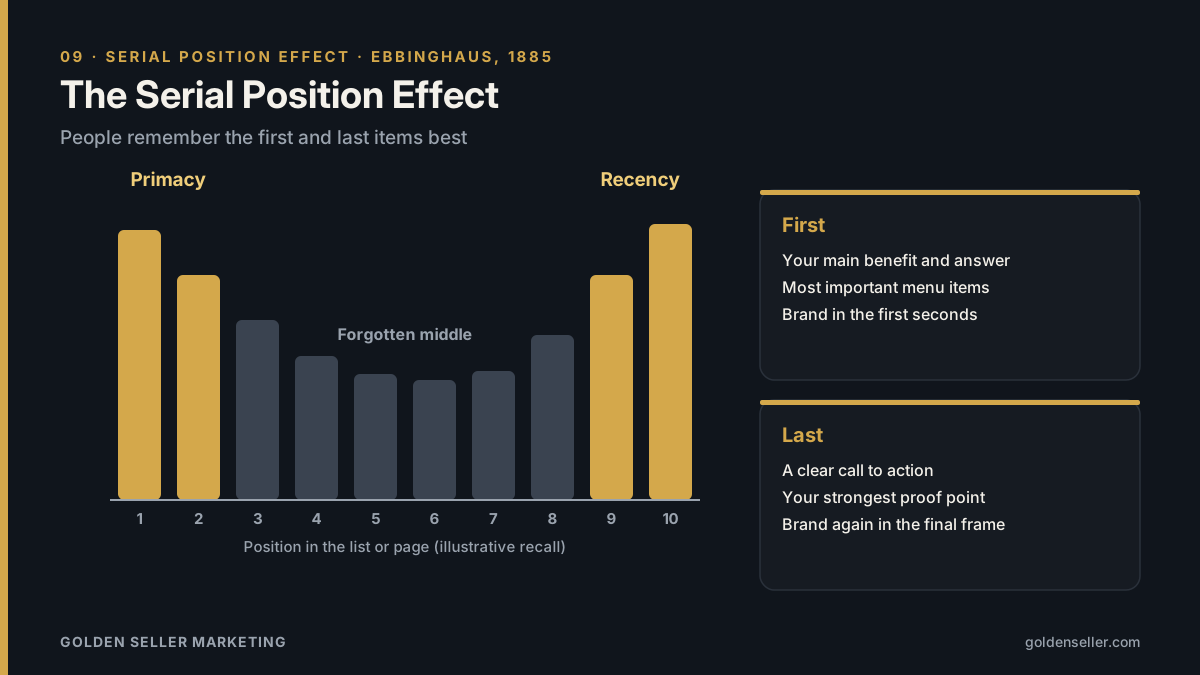
What is the serial position effect?
German psychologist Hermann Ebbinghaus first described the pattern in the late 1800s during his pioneering memory experiments. Later researchers, including Bennet Murdock in the 1960s, documented it in detail. The effect has two parts:
- Primacy effect: Items at the beginning are remembered well, likely because they get more attention and rehearsal.
- Recency effect: Items at the end are remembered well, likely because they’re still fresh in short-term memory.
It’s one of the most consistently replicated findings in memory research.
Why it matters in online marketing
Attention online is short, and people skim. The beginning and end of almost everything get the most attention:
- Navigation menus: The first and last items tend to get noticed most.
- Headlines and page openings: The first lines decide whether someone keeps reading.
- Feature and benefit lists: Middle items get skimmed past.
- Videos and ads: The first seconds earn attention; the final frame often carries the brand and the call to action.
- Email subject lines and preview text: The opening words do most of the work.
How to apply the serial position effect
Lead with your strongest point
Put your main benefit or answer first. On a service page, the first section should tell visitors what you do, who it’s for and why you’re the right choice.
End with the action
Close every page, email and video with a clear call to action. The final impression is the one most likely to be acted on.
Order navigation deliberately
Put the most important pages at the start of your menu and a key action (such as Contact) at the end.
Bookend lists
In feature lists, testimonials and pricing comparisons, place the most persuasive items first and last.
Keep lists short
The longer the list, the bigger the forgotten middle. Combine this with Hick’s Law: fewer, clearer items work better.
Repeat key messages at the start and end
In presentations and long-form content, state the key point at the beginning and restate it at the end.
The serial position effect and branding
First impressions and last impressions both shape a brand. The first time someone encounters your brand, the homepage, the first ad, the first phone call, sets expectations. The last interaction is what they carry away. This overlaps with the peak-end rule, which focuses on emotional moments, while the serial position effect focuses on order and memory.
In video and audio advertising, brands often show their name and logo early and again at the end so that recognition is reinforced at both memorable positions.
Common mistakes
- Burying the main message in the middle of a long page or presentation.
- Weak openings such as long company histories before the visitor knows what you offer.
- Ending without a next step.
Frequently asked questions
What is the difference between primacy and recency?
Primacy is better memory for the first items in a list; recency is better memory for the last items.
How does the serial position effect affect web design?
It suggests putting key messages at the top, important navigation items at the start and end of menus, and a clear call to action at the end of each page. Our web design team builds pages with this structure.
Put behavioral psychology to work for your brand
Golden Seller Marketing is a San Diego digital marketing agency built on behavioral marketing: we use how people actually notice, decide and remember to shape websites, ads, content and brands. This article is part of our series on the 11 laws of human psychology every marketer should know. Explore our branding, web design and online marketing services, or contact us at (855) 853-3456.